

How the standard is governed.
A standard is only as trustworthy as the process behind it, so here is exactly who runs this one, how it stays neutral, and how the specification changes.
The founders

Alex Oleynik
Co-founder · Specification
Leads the technical direction of the specification and the working-group process. Focused on making conformance objective and the protocol genuinely interchangeable across dealer systems.
LinkedIn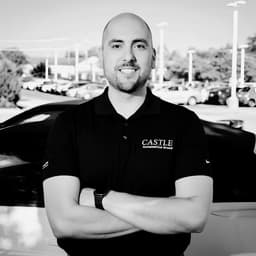
David Ortiz
Co-founder · Dealer adoption
Leads dealer adoption and the retail operations perspective. Brings three decades in automotive sales and dealership operations to keep the standard grounded in how stores actually run.
LinkedInGray Scott
Co-founder · Community & industry
Leads community and industry adoption. Connects the council to dealers, vendors, and the automotive AI community, and drives the events and education motion.
Brian Pasch
Co-founder · Data & dealer education
Brings decades of automotive retail education and data strategy to the standard. Focused on helping dealers understand what agentic AI actually changes, and on the data transparency the standard depends on.
How it’s organized
The council, its founders and founding members, maintains the specification and ratifies releases. Around them, participation is open to the whole industry.
How a change is made
Every change to the specification moves through the same open path, from proposal to ratified release.
- 01
Propose
Anyone can submit a change to a spec section; working groups and members raise proposals directly.
- 02
Working-group review
The relevant group reviews it for correctness, interoperability, and compliance impact.
- 03
Public comment
Substantive changes open for comment so implementers and dealers can weigh in before adoption.
- 04
Adopt & version
Accepted changes merge under semantic versioning; breaking changes need a MAJOR bump and a deprecation window.
- 05
Ratify
Once feature-frozen and reviewed, the council ratifies the release. Ratified versions change only by the rules above.
The full lifecycle and versioning rules live in Conformance & Versioning §2.
Staying neutral
Neutrality has to be built into the rules, not just promised. These rules are non-negotiable.
- No favorites
- No vendor gets preferential treatment in the spec or in certification.
- Recusal
- Members recuse from any decision touching their own commercial interests.
- Open certification
- Criteria are public and identical for everyone; there is no pay-to-pass tier.
- Worked in the open
- Working-group membership and adopted decisions are published, and every accepted change is noted on Updates with the version it lands in. Proposals reach us by email or the contact form today, and move to a public tracker as the source repository opens.
Licensing and IP
A standard nobody can safely implement is not a standard. Here is the position, in the terms a legal review asks about.
- The spec and schemas: Apache 2.0
- Published under the Apache License 2.0. Implement it in a commercial product, fork it, or vendor the schemas into your build. No fee, no permission needed, no field-of-use restriction.
- An explicit patent grant
- Apache 2.0 is used for one specific reason: every contributor grants a royalty-free patent licence covering their contribution, and it terminates for anyone who sues over it. A Creative Commons licence says nothing about patents, which is why the normative material does not use one.
- Documentation: CC BY 4.0
- Prose, the Directory and release notes stay under CC BY 4.0. Quote it, translate it, republish it with attribution.
- Contributions: nothing to sign
- There is no contributor licence agreement. A contribution arrives under whatever licence already covers the file it changes, asserted by the Developer Certificate of Origin on commits and by a standing Note Well everywhere else. You keep your copyright; no assignment is requested and none is wanted. Editors merge and the council ratifies, so the process is open without the sign-off being ambiguous.
- Trademarks are separate
- The name, the logos and the conformance mark are not covered by either licence. Implementing the standard does not grant the right to display the mark; that comes from certification.
- Who grants the licence
- Copyright is held by Creative Code, Inc., and the grants above come from them. The council is the name of the effort, not a separate legal entity, so it is named here rather than left to inference: a licence from a body that does not exist is not a licence.
- If this moves to a neutral host
- The intent is to place the specification with a neutral standards body. When that happens, that body’s contribution and patent policy replaces the arrangement above, and the change is announced before it takes effect, not after.
Partners & endorsers
The founding cohort spans DMS, CRM, website platforms, AI-agent vendors, dealer groups and agencies: 50 dealer seats and 30 vendor seats, deliberately small so the working sessions are real work. Founding members write v1 with us and certify first.
Members are listed here once they sign, and not a moment before. A logo wall you cannot verify is worth less than an empty one, and a standard that pads its partner list has already told you what its conformance mark is worth. Take a seat in the founding cohort.
A note on the name
This body is not affiliated with the Automotive Standards Council, which is a separate and unrelated organization. The similarity in name is unintended.
Want a seat at the table?
Founding members write v1 and set the certification criteria before any of it ratifies. Dealers join free, vendors take one of 30 seats, and anyone can propose a revision in the open today without joining anything.